Denver residents are fortunate to have access to high-quality water sourced directly from mountain snowmelt and the South Platte River. However, as this water travels through the rocky terrain of the Front Range and into the city’s aging infrastructure, it picks up significant amounts of dissolved minerals like calcium and magnesium. While these minerals are generally safe for consumption, they are incredibly destructive to the mechanical systems inside your home. Over time, the chemical reaction between these minerals and the heat in your plumbing system creates a stubborn, rock-like buildup known as scale. This “silent killer” of plumbing efficiency can gradually restrict water flow, corrode metal surfaces, and ultimately lead to system-wide failures that require more than a simple fix.
In this blog, we will explore how Denver’s unique water chemistry affects your pipes and fixtures and identify the critical signs that indicate a repair is no longer sufficient and a full replacement is necessary.
Decoding the Mineral Content of Denver’s Water Supply
Understanding the impact of hard water starts with looking at the specific data provided by Denver Water. Our local supply is typically classified as “moderately hard,” with a range of 40 to 80 parts per million (ppm) or 3 to 5 grains per gallon. While this may sound lower than the extreme hardness found in the Midwest, the Mile High City’s dry climate and high altitude accelerate evaporation, leaving mineral deposits more quickly. When water is heated, these minerals crystallize and adhere to the nearest surface, beginning a cycle of accumulation that eventually chokes your plumbing system.
Several factors contribute to the “hardness” profile of the water entering your home:
- Geological Runoff: As snowmelt flows through limestone and dolomite deposits in the Colorado mountains, it dissolves small amounts of calcium and magnesium.
- pH Fluctuations: Denver Water actively manages pH levels to prevent lead leaching from older service lines, but these adjustments can sometimes affect the ease with which minerals precipitate from the water.
- Seasonal Variability: Hardness levels can spike during the spring runoff when the volume of water moving through the mountains is at its highest, carrying more sediment and minerals than usual.
- Temperature Sensitivity: The hotter your water heater is set, the faster these minerals will solidify and settle at the bottom of the tank or inside your pipes.
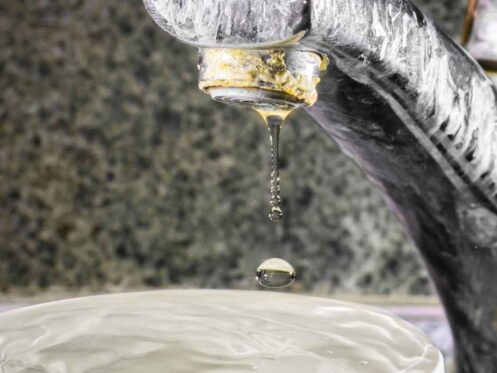
- High Elevation Evaporation: In our arid environment, even small leaks or drips evaporate rapidly, leaving behind a white, crusty residue that can permanently etch chrome and stainless steel.
By the time you notice white spots on your glassware or a decrease in soap lather, the minerals have likely already begun to form a thin layer of scale inside your hidden plumbing lines. This internal buildup is the primary driver of premature appliance failure and reduced water pressure in homes across the Denver metro area.
Pipe Scale: The Invisible Culprit Behind Low Pressure
One of the most insidious effects of Denver’s hard water is the gradual narrowing of your home’s internal piping. This process, often referred to as “calcification,” occurs most frequently in copper and galvanized steel pipes. As layers of scale build up on the inner walls, the pipe diameter decreases, forcing your water system to work harder to maintain flow. This restriction creates a dual problem: it reduces water pressure at your taps and increases internal pressure on the pipe joints, which often leads to pinhole leaks.
Homeowners should monitor these indicators to determine if their pipes are beyond the point of repair:
- Persistent Pressure Loss: If cleaning your faucet aerators does not restore pressure, the restriction is likely deep within the main supply lines.
- Brown or Flaky Water: This is often a sign that mineral scale has combined with internal pipe corrosion, causing it to break loose and enter your drinking water.
- Frequent Pinhole Leaks: Multiple leaks in different areas of the home suggest that the pipe walls have been thinned by “pitting” corrosion caused by mineral deposits.
- Metallic Tastes: As scale buildup worsens, it can react with the copper or lead in older pipes, altering the flavor and safety of your water.
- Audible “Clanging” in Walls: This “water hammer” effect is often exacerbated by narrow pipes that cannot accommodate the water’s velocity.
While a plumber can sometimes clear a localized blockage, a pipe that has been significantly narrowed by scale is usually a candidate for replacement. In modern Denver renovations, we often recommend transitioning to PEX (cross-linked polyethylene) piping, which is naturally resistant to scale buildup and more resilient to the expansion and contraction caused by Colorado’s varied temperatures.
Fixture Fatigue: When Lime Scale Destroys Aesthetics and Function
Your faucets, showerheads, and valves are the most visible victims of hard water. Because these fixtures are where water is released into the air, they are the primary sites for rapid evaporation and mineral crystallization. In many Denver homes, the white, chalky substance known as “limescale” can become so thick that it physically prevents handles from turning or clogs the tiny spray holes in a high-end showerhead. Beyond the aesthetic frustration of dull, spotted finishes, this mineral attack can permanently damage the internal seals and cartridges that prevent leaks.
These symptoms often signal that it is time to replace your fixtures rather than attempting a repair:
- Pitted Metal Finishes: Once the minerals have eaten through the protective chrome or nickel plating, the underlying metal is exposed to air and will continue to corrode.
- Seized Internal Cartridges: If a faucet handle becomes difficult to turn or “gritty,” minerals have likely entered the delicate internal mechanism, making a simple washer replacement ineffective.
- Erratic Shower Spray: When more than 50% of the nozzles on a showerhead are blocked by scale, the internal pressure can cause the fixture to crack or leak at the arm connection.
- Dripping Spouts: Hard water deposits on the “seat” of a valve prevent a watertight seal, leading to a constant drip that can waste hundreds of gallons of water per year.
- Visible Cracking in Plastic Components: Limescale makes plastic and rubber parts brittle, leading to sudden breaks in pull-out sprayers or handles.
Cleaning with vinegar can offer a temporary reprieve, but it cannot fix the microscopic “pitting” that occurs on the metal surfaces. For many homeowners, upgrading to fixtures with “Touch-Clean” rubber nozzles or ceramic disc valves provides a much better long-term solution to the challenges posed by Denver’s water supply.
The Costly Impact on High-Efficiency Water Heaters
The water heater is the most vulnerable appliance in your Denver home because it is the “ground zero” for mineral precipitation. As the water temperature rises, calcium and magnesium precipitate from the solution and settle to the bottom of the tank. In a standard tank-style heater, this creates a thick layer of “sediment” that acts as an insulator. The burners or heating elements must first heat this layer of rock before heating the water, resulting in significant energy waste and causing the metal at the bottom of the tank to overheat and eventually fail.
Hard water damage to water heaters typically manifests in several ways:
- The “Kettling” Sound: A popping or banging noise inside the tank indicates steam bubbles struggling to escape through the thick layer of mineral sediment.
- Slower Recovery Times: If it takes significantly longer to reach hot water than it used to, the heating element scale is likely the cause.
- Reduced Tank Capacity: A heavy buildup of minerals can occupy several gallons of space inside your tank, leaving you with less hot water for showers and laundry.
- Premature Element Burnout: In electric heaters, minerals can encase the element, causing it to overheat and “snap” due to a lack of direct water contact.
- Tankless Heat Exchanger Failure: For tankless units, scale can clog the narrow passages of the heat exchanger in as little as two years if the system is not professionally descaled.
In Denver, we frequently see water heaters fail years before their warranties expire due to mineral buildup. While annual flushing is a critical maintenance step, a tank that has more than three inches of solidified sediment is usually more expensive to “save” than it is to replace. For homeowners switching to high-efficiency tankless models, a water treatment system is almost always required to protect the investment.
2026 Water Treatment Solutions for Mile High Homes
As we move into 2026, the technology available to Denver homeowners for managing hard water has become significantly more advanced and user-friendly. Residents are no longer limited to bulky, salt-intensive systems that require constant heavy lifting. Modern water treatment options now include smart softeners that connect to your home’s Wi-Fi to provide real-time alerts about water usage and salt levels, as well as salt-free conditioners that are ideal for those on sodium-restricted diets or those who prefer a more eco-friendly approach.
These 2026 solutions offer the best protection for your plumbing infrastructure:
- Smart Ion-Exchange Softeners: These units use advanced sensors to regenerate only when necessary, saving thousands of gallons of water per year compared to older timer-based models.
- Salt-Free Water Conditioners: Rather than removing the minerals, these systems change the chemical structure of the calcium so it cannot “stick” to your pipes or fixtures.
- Electronic Descalers: These compact devices use electromagnetic waves to prevent mineral buildup in the main line, making them an excellent choice for townhomes or condos with limited space.
- Whole-Home Filtration Combos: Modern systems can now remove minerals while simultaneously filtering out the chlorine and heavy metals used to treat Denver’s water.
- App-Integrated Monitoring: 2026 models can detect sudden changes in water hardness or potential leaks and send an immediate notification to your smartphone.
Implementing a water treatment strategy is the only way to truly stop the “repair-to-replacement” cycle. By neutralizing the minerals at the point of entry, you can effectively double the lifespan of your faucets, dishwasher, and water heater while ensuring your pipes remain clear and pressurized for decades to come.
Protect Your Home with Jim Needham Heating Cooling Plumbing & Drain
Don’t let Denver’s moderately hard water lead to a major plumbing catastrophe in your home. Whether you are dealing with low water pressure, crusty fixtures, or a noisy water heater, the team at Jim Needham Heating Cooling Plumbing & Drain is here to help. We specialize in diagnosing mineral damage and providing honest assessments of whether repair or full replacement is the most cost-effective option. From installing high-tech 2026 water softeners to repiping homes with scale-resistant materials, we have the expertise to safeguard your plumbing system against the Front Range’s unique environmental challenges.
Contact us today to schedule your water quality assessment and ensure your home’s pipes and fixtures are built to last.
Frequently Asked Questions
How can I tell if my Denver home has hard water?
The most common signs include a white, chalky film on your shower doors, spots on your glasses after they come out of the dishwasher, and a feeling that your skin is “sticky” or dry after bathing. You can also look for a “moderately hard” rating on the annual water quality report provided by Denver Water.
Does a whole-home water softener remove minerals or simply replace them?
A traditional ion-exchange water softener physically removes the calcium and magnesium ions and replaces them with a small amount of sodium. A water “conditioner” or “descaler” does not remove minerals; it prevents them from adhering to surfaces.
Is it worth fixing a 10-year-old water heater with heavy sediment?
Generally, a water heater older than 8 years and with significant sediment buildup is nearing the end of its useful life. The cost of a professional flush and the risk of the tank leaking shortly after usually make a replacement the more sensible financial decision.
Can hard water cause my toilet to run constantly?
Yes, mineral buildup can collect on the flush valve or the “flapper” inside your toilet tank. This prevents a tight seal, causing water to constantly leak from the tank into the bowl, which can significantly increase your monthly water bill.
Are salt-free water conditioners as effective as salt-based softeners?
Salt-free systems are highly effective at preventing scale buildup in your pipes and water heater, the primary goal of plumbing protection. However, they do not provide the “slippery” feeling in the shower or the increased soap lather that many people associate with salt-based softeners.